

This page uses javascript to help render elements, if you have problems please enable javascript.
 
You are now inside the main content area


left col

Annual Report 24-25

right col
 
left col

Musicology Expert, Students Recover Music of Bolivian Composer

right col
 
left col

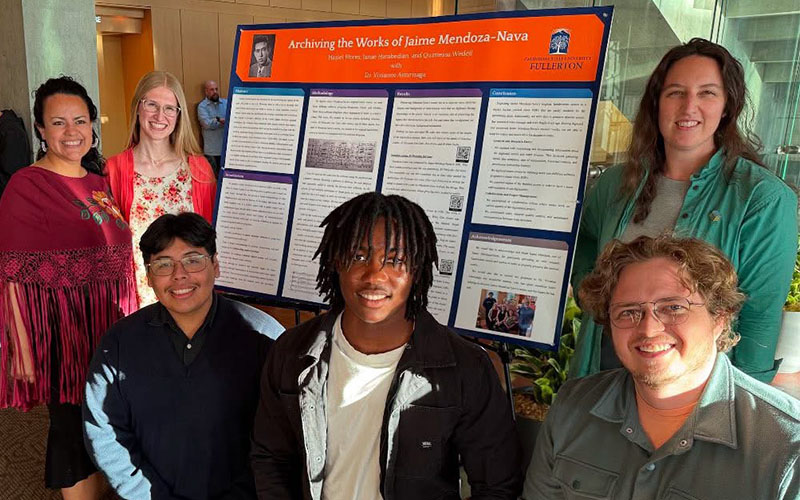
Vivianne Asturizaga with group of students presenting research

right col
 
left col

In 2024 and 2025, Vivianne Asturizaga, assistant professor of music, led an international research initiative that brought together student music scholars with archivists, orchestras and communities across the Americas.

The project focused on recovering and performing the music of Bolivian American composer Jaime Mendoza-Nava, whose works remain largely unpublished and unknown despite his contributions to film and concert music throughout his lifetime from 1925-2005.

As a member of the Walt Disney Studios music department, he scored TV programs such as “Zorro” and “The Mickey Mouse Club,” among many other projects.

Asturizaga mentored graduate and undergraduate students through the Summer Undergraduate Research Academy and the Engaging Graduate Students in Research, Scholarly and Creative Activities programs.

The Mendoza-Nava project exemplifies high-impact practices at Cal State Fullerton by combining research, mentorship, global learning and collaborative scholarship.

Supported by a Research, Scholarship, and Creative Activity (RSCA) grant, the initiative demonstrates how digital scholarship, international collaboration, and student-centered learning can intersect to preserve and elevate underrepresented musical traditions. 

The project included CSUF students from a wide range of majors including music education, composition, history and psychology, reflecting the interdisciplinary potential of music to connect creative and historical research.

Students conducted research at the Mendoza-Nava Archive in Los Angeles, where they developed skills in archiving, historical analysis and collaborative editing. They examined Mendoza-Nava’s original manuscripts and spoke directly with the composer’s son — who is also curator of Mendoza-Nava’s legacy — as he shared personal family stories.

“When students see their archival work performed on stage — whether in California or Bolivia —they understand that music history is not just a record of the past, but a living process. From manuscript to stage, it becomes a journey of discovery, recovering forgotten sounds, reshaping how we listen today, and ultimately helping to imagine a more inclusive and resonant future,” said Asturizaga.

Read the full story

right col
 
left col
right col
 
left col
right col
 
left col
right col