

This page uses javascript to help render elements, if you have problems please enable javascript.
 
You are now inside the main content area


left col
right col
 
 
left col
right col
 
left col
right col
 
left col

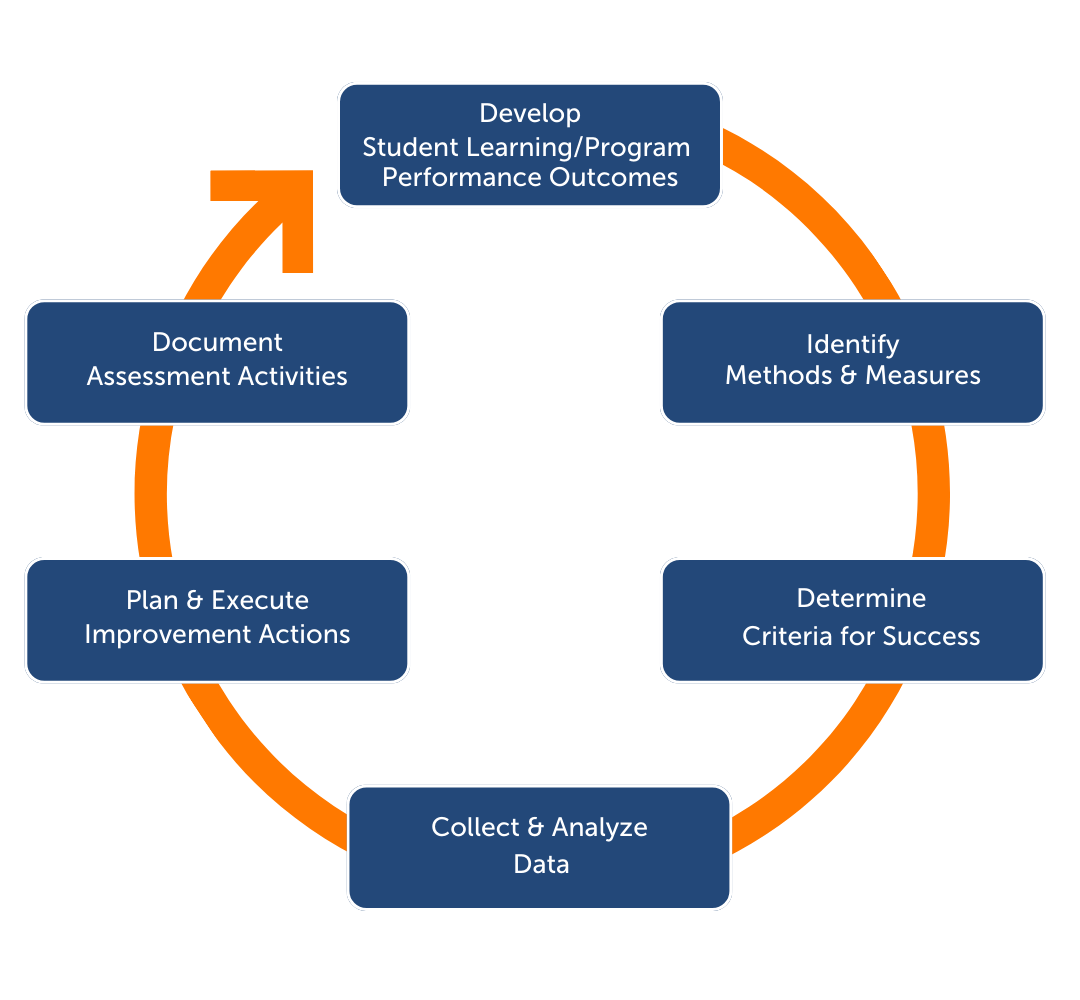
Assessment is an ongoing process aimed at continuous improvement of student learning and university operations. At CSUF, assessment follows a six-step cycle:

right col
 
 
left col

orange circular arrow passing through six blue recatangles that represent assessment steps

CSUF's Six-Step Assessment Process

  1. Develop student learning outcomes and performance outcomes that align with the university's mission, the university's student learning goals, and (if applicable) the accreditation requirements of the respective discipline.
  2. Develop and implement methods of assessment involving direct and indirect measures.
  3. Determine criteria for success.
  4. Collect and analyze data.
  5. Plan and execute improvement actions.
  6. Document assessment and improvement activities.
right col


left col

University Assessment Policy

Developed by the Assessment & Educational Effectiveness Committee and approved by the Academic Senate, CSUF officially established the University Assessment Policy Statement in March 2014.  The same committee also approved the University's Assessment & Educational Effectiveness Plan.

View the Policy (UPS 300.022)


right col
 
left col
right col
 
 
left col
right col
 
left col
right col
 
left col

University Student Learning Goals

Undergraduate Learning Goals

Undergraduate Learning Goals

Through universitywide collaboration, CSUF developed a set of universitywide Learning Goals (UPS 300.003) in May 2014 that were renamed Undergraduate Student Learning Goals in September 2017.  

  1. Demonstrate intellectual literacy through the acquisition of knowledge and development of competence in disciplinary perspectives and interdisciplinary points of view.
  2. Think critically, using analytical, qualitative and quantitative reasoning, to apply previously-learned concepts to new situations, complex challenges and everyday problems.
  3. Communicate clearly, effectively, and persuasively, both orally and in writing.
  4. Work effectively as a team member or leader to achieve a broad variety of goals.
  5. Evaluate the significance of how differing perspectives and trends affect their communities.
  6. Recognize their roles in an interdependent global community.


General Education Learning Goals

General Education Learning Goals

Led by the Senate General Education (GE) Committee, incorporating feedback from diverse campus constituents, CSUF developed a set of General Education: Programmatic Student Learning Goals and Learning Outcomes (UPS 411.203) in spring 2015. Revisions were made to the GE goals and outcomes in July 2023. 

  1. Demonstrate and apply their understanding of fundamental concepts, methods, and theories in natural sciences and mathematics, arts and humanities, and social sciences.
  2. Seek and acquire relevant information and apply analytical, qualitative, and quantitative reasoning to previously learned concepts, new situations, complex challenges, and everyday problems.
  3. Develop ideas and communicate them competently and ethically, verbally or nonverbally, both orally and in writing, in a variety of contexts.
  4. Develop skills to collaborate effectively and ethically as leaders and team members.
  5. Develop and apply critical awareness, intercultural skills, and informed appreciation that advance diversity, equity, and inclusion in their immediate and larger communities.


Graduate Learning Goals

Graduate Learning Goals

Led by the Senate Graduate Education Committee, incorporating feedback from diverse campus constituents, CSUF developed a set of Graduate Student Learning Goals (UPS 300.041) in May 2017. Revisions were made to Graduate Student Learning Goals 5 and 6 in May 2023 . As appropriate to the discipline and the degree program, graduate students should be able to demonstrate:

  1. Knowledge, skills, and professional dispositions including higher order competence in disciplinary perspectives and interdisciplinary points of view;
  2. The ability to access, analyze, synthesize, and evaluate complex information from multiple sources and in new situations and settings;
  3. Advanced communication skills;
  4. The ability to work independently and in collaboration with others as artists, practitioners, researchers, and/or scholars;
  5. The ability to determine and apply appropriate methods and technologies to address problems that affect their communities; 
  6. A commitment to social justice and ethical leadership within diverse communities and an interdependent global community.


right col
 
left col
right col
 
 
left col


right col
 
left col
right col
 
left col
right col
 
left col
right col
 
left col
right col
 
 
left col
right col
 
left col
right col
 
left col
right col
 
left col
right col
 
 
left col
right col
 
left col
right col
 
left col
right col
 
left col
right col
 
left col
right col
 
left col
right col
 
left col
right col
 
left col
right col