

TABLE OF CONTENTS
General Student Organization Policies
CSU Executive Order 1068 (CSU Policy regarding Student Orgs)
CSUF Anti-Hazing Policy (Cal State Fullerton policy regarding hazing)
State of California Hazing Policy (California policy regarding hazing)
Report Allegations of Hazing
Allegations of violation of state law or university policies regarding hazing are handled by the Office of Student Life & Leadership, Dean of Students Office, Office of Student Conduct or University Police for appropriate disciplinary and/or criminal investigation and action. As outlined in the Executive Order 1098, Student Conduct Procedures, and the Student Organization Judicial Procedures, due process will be followed including right of appeal. Nothing in this policy is intended to prevent or prohibit a victim of hazing from filing a complaint with the police in addition to reporting the event(s) to the Office of Student Life & Leadership or Dean of Students Office, as described above.
Victims of hazing may also complete a CSUF Incident Reporting Form to share their concerns anonymously. More information on hazing, reporting, and student conduct policies can be found here.
In addition, official recognition of a student organization may be withdrawn for hazing or conspiracy to haze as defined in the California Code of Regulations, Title 5, Standards for Student Conduct, Section 41301(b)(8). Individual students may be disciplined for hazing under Section 41301(b)(8).
Student Organization Suspension Policy
All student organizations are expected to follow all CSUF Student Conduct policies. Failure to do so makes the student organization subject to possible investigation. The investigation process will be found HERE on the Student Conduct website.
If there is any other misconduct, any student may report to either Student Conduct, the Dean of Students office, or the Office of Civil Rights. For any additional information about the investigation process, visit the Frequently Asked Questions section.
Time, Place, & Manner / Free Speech & Expression Event Policies
Administrative Guidelines Regarding Freedom of Expression and Expressive Conduct are outlined in Interim Systemwide Time, Place and Manner Policy issued pursuant to Section II of the Standing Orders of the Board of Trustees of the California State University, as further delegated by the Standing Delegations of Administrative Authority. The Campus president may delegate authority and responsibility described in this policy to other Campus officials pursuant to Section VI of the Standing Orders of the Board of Trustees of the California State University.
Cal. Education Code section 89031.
CSU Standards for Student Conduct, 5 California Code of Regulations, sections 41301-41302. Use of CSU Buildings and Grounds, 5 California Code of Regulations, sections 42350-42356.
Please review
Interim Systemwide Time, Place and Manner Policy
for the full policy information. For Cal State Fullerton Campus Addendum see (Insert Link).
Event Policies
I. Event Planning Overview
- The EAP must be completed and approved within the Titan Link prior to the event taking place and prior to advertising the event.
- All submissions are a request for space, not a confirmation. Event Reservation Requests are not approved until you receive confirmation via TitanLink. Additional confirmations may be required if the reservation request is for space within the Titan Student Union, Student Recreation Center, Housing & Residence Life.
- Event Reservation Requests for Student Life & Leadership must be submitted at least seven (7) business days in advance and a maximum of one (1) semester prior for outdoor venues. Classroom reservations are only accepted at the start of the semester and not extending past the end of that semester.
- Events including but not limited to, cultural shows, festivals, fairs, those that require a food permit, class projects and the like, may require a Special Event Consultation with University staff. See Event Approval Process.
- All requests are subject to consideration of Systemwide Time, Place and Manner Policy and the Cal State Fullerton Addendum.
- A member of the organization must be present during the Event scheduled.
- Student organizations may be held accountable through campus conduct procedures for the actions of members or the actions of individuals at my event for any violations of the Student Code of Conduct.
- The Office of Student Life & Leadership along with any University Office acting as custodian of a space reserves the right to cancel or void any Event Reservation Request if it does not comply with university policies and/or the reservation details are not finalized.
- It should be recognized that instructional programs have priority in scheduling University facilities. The University reserves the right to cancel this Event due to an unanticipated Campus academic need.
- Failure to comply with the provisions set forth in campus regulations and expectations outlined in this document may result in the suspension of campus privileges.
- All off-campus events must be submitted through TitanLink for review and approval. While the approval process for off-campus events differs from that of on-campus events, student organizations are still required to submit all off-campus events through TitanLink before the event takes place.
II. Venue Reservations
Student Clubs & Organizations can reserve space on campus for free or at a reduced cost depending on the facility and availability.
At this time reservations for Classrooms, Outdoor spaces, Athletic spaces, Titan Student Union spaces, Housing & Residence Life and the Student Recreation Center can be conducted through TitanLink.
These reservations will also be automatically marketed through the Events Calendar in TitanLink once approved.
Reservable Locations are available for Outdoor Spaces, Classroom Spaces, Titan Student Union and Housing & Residence Life. See reservation information for these locations below.
A. Submit Event Request Form
All Club & Organization Presidents and Treasurers are able to reserve spaces through TitanLink. Additional members are able to make reservations as long as they are designated as Event Planners in TitanLink.
-
Visit your organization's TitanLink page.
-
Click on the "CREATE EVENT" button within your organization's TitanLink page.
-
Remember only presidents, treasurers, and event planners can create events in TitanLink.
-
To make a member an event planner, please visit: Adding a Member as an Event Planner .
-
-
SUBMIT your event information.
-
Submission form will require details of the event, such as:
-
-
Event Title, Theme, & Description
-
Time & Place – Date(s) & Time of event, set up, etc.
-
Event Location Venue Request
-
Additional event details: Budget/Funding Source; Estimated Attendance (to consider appropriate spaces) and population(s); Equipment, Catering, Decorations; etc.
-
-
-
B. Receive Approval of Denial via TitanLink
-
Request(s) will be reviewed by Student Life & Leadership or the appropriate office and will be evaluated.
-
Student Life & Leadership directly oversees the reservations for outdoors venues (e.g., Titan Walk, Tuffy Lawn). Event requests will be reviewed and responded to within 7 business days. Student Life & Leadership serves as a liaison for classrooms, athletic spaces, and KHS rooms.
-
A potential referral to the Campus Activities Committee may be required for large-scale or special events.
C. Venue Management via TitanLink
-
-
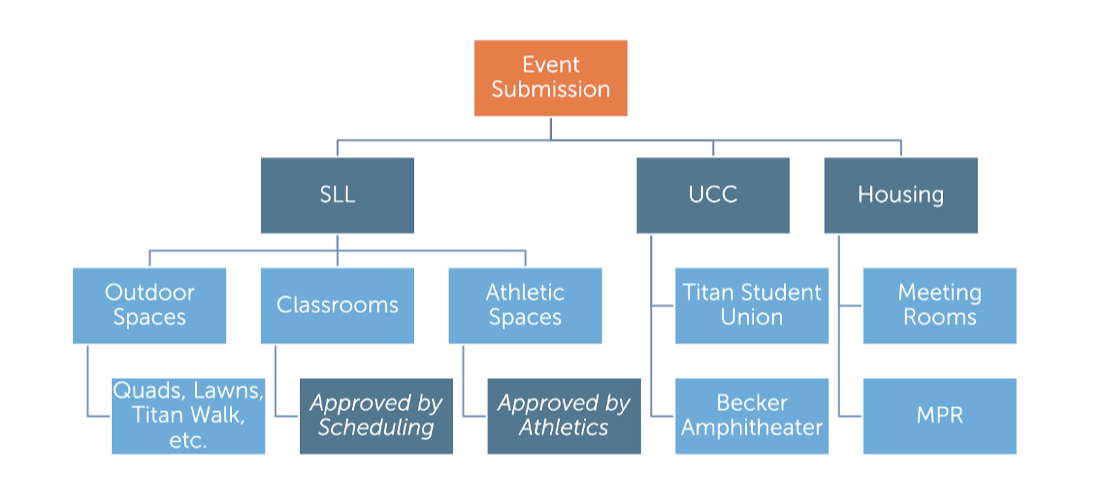
Available venues are managed by different departments on campus. Each department has their own approval process and space specific guidelines.
-
Student Life & Leadership
-
Outdoor Venues (Central Quad, Humanities Quad, ECS Lawn, etc.)
-
Athletic Spaces & Classrooms
-
NOTE: Classrooms must be reserved three weeks after the academic school year has started due to class scheduling.
-
-
-
Titan Student Union Events Center Spaces (Titan Student Union)
-
The Portola Pavilion, Meeting Rooms in TSU, Becker Amphitheater, Titan Theater, etc.
-
-
Housing and Residential Engagement
-
Meeting rooms in the Residence Halls & MPR.
-
-
-
Areas not listed, may be reserved through the department who oversees the area. When making a request, specify which spaces you would like to reserve and SLL will direct you to the department that manages the space. Spaces include but are not limited to:
-
Parking lots and structures, the Arboretum, the Alumni House, Meng Concert Hall, etc.
-
Please note that fees may apply to utilize these spaces
-
-
Organizations are responsible for keeping spaces clean and tidy. Spaces must be restored to their original condition. Trash must be put into trash cans. If you need trash bins, please contact Facilities. Failure to comply with these guidelines may result in loss of access for reserving spaces on campus or org recognition.
-
Below is a flow chart for reference
-
III. Event Approval Process Tiered Model
| Item |
Tier One |
Tier Two |
Tier Three |
|---|---|---|---|
|
Event Approval Process (EAP) Submission and Event Approval* Timelines SLL Approval is contingent on the successful completion and review of all required materials |
EAP Submission: 1 week in advance SLL Approval: 2 business days in advance |
EAP Submission: 3 weeks to 1 month in advance SLL Approval: 1 week in advance |
EAP Submission: 2 months in advance SLL Approval: 2 weeks in advance |
|
Activity Description |
Simple Tabling Regular Meetings Basic workshops Basic Student Organization gathering (ex: tabling event to promote a single organization) |
Programs Events Resource Fairs |
Large Scale Activities Programs Events Vendor Markets Carnivals |
|
Space Type |
Outdoor Tabling Classrooms during regularly scheduled hours Titan Walk |
All spaces reservable on campus managed by SLL |
All spaces reservable on campus managed by SLL |
|
Safety and Security Assessment |
Not necessitated |
May be necessitated |
May be necessitated |
|
Risk Management: Event Insurance |
Not necessitated |
May be necessitated |
May be necessitated |
|
Risk Management |
Not necessitated |
May be necessitated, risk management assessment required and any corresponding directives must be followed (ex: waivers) |
Necessitated, all university processes including risk management assessment, plans, and waivers requirements must be followed. |
|
Publicity |
Within the Organization CSUF Community |
CSUF Community Invited Guests |
Inside and Outside of the University Public |
|
Speakers |
CSUF Staff and Faculty CSUF Students CSUF Alumni |
Local, off-campus contracted performers |
Nationally and Internationally Recognized Performers |
|
Performer(s) |
CSUF Staff and Faculty CSUF Students CSUF Alumni |
Local, off-campus contracted performers |
Nationally and Internationally Recognized Performers |
|
Fire Marshal |
Not necessitated |
May be necessitated |
May be necessitated |
|
Outdoor Amplified Sound |
Outdoor Amplified Sound is not part of the event |
May be requested |
May be requested |
|
Food |
May be included: Self-Catered only (ex: prepackaged snacks, catering picked up from restaurants) |
May be included: Pre-approved on-campus vendors (ex: preapproved food trucks, Titan Eats) |
May be included: Off Campus Vendors with approval from Environmental Health & Safety AND Risk Management |
|
Environmental Health & Safety (non-food) |
Not necessitated |
May be necessitated |
May be necessitated |
|
Ticketing |
Ticketing is not part of the event |
Ticketing may be part of the event and University process must be followed |
Ticketing may be part of the event and University process must be followed |
|
Commercial Activity and Sales |
Commercial activity and/or sales is not part of the event |
Commercial activity and/or sales may be part of the event; University process must be followed |
Commercial activity and/or sales may be part of the event; University process must be followed |
|
Fundraising and Philanthropy |
Fundraising/philanthropy may be part of the event |
Fundraising/philanthropy may be part of the event |
Fundraising/philanthropy may be part of the event |
|
Crowd Size * |
<200 |
<300 |
300+ |
Tier One
Tier One events must be submitted in Titan Link via Event Submission at least 5 business days prior to the date of the event. Tier One events are activities that include simple tabling, regular meeting spaces, and basic workshops facilitated by university employees and students. The event proposals may include food, beverages, or outdoor amplified sound requests. Additionally, activities do not necessitate risk management, safety and security assessment, or Fire Marshal approval.
Tier One events must be permitted in the Event Application Process and require that space reservations are reserved through the outlined processes. Spaces that may be utilized for Tier One events include approved outdoor tabling locations and classrooms during regularly-scheduled business hours. Tier One events must be permitted by the Student Life and Leadership 48-hours in advance in order for the event to take place.
Tier Two
Tier Two events must be submitted in Titan Link via Event Submission at least three weeks prior to the date of the event. Tier Two events are programs and activities that include speakers/activities that are publicized on campus outside of the organization. If the event involves contracts with off-campus vendors/speakers, the event would be considered, at minimum, Tier Two. The events may include food, beverages, outdoor amplified sounds, and facilities requests. Tier Three speakers/performers/activities may necessitate risk management, safety, and security assessment, and/or Fire Marshal approval.
Tier Two events must be approved in the Event Approval Process and require that space reservations are reserved through outlined processes. Tier Two events may need the event planner to attend a Campus Activities Committee (CAC) meeting to assess the event for what is needed to succeed from campus partners. CAC meetings occur every two weeks and the event planner must create a proposal for their event to present to these campus partners. Spaces that may be utilized for Tier Two events include all reservable spaces managed by Student Life and Leadership. Tier Two events must be approved by Student Life and Leadership one week in advance in order for the event to take place.
Tier Three
Tier Three events must be submitted in the Event Approval Process at least eight weeks prior to the date of the event. Tier Three events are large-scale activities that may be open to the general public and may include ticketing. Tier Four events typically include contracts with off-campus vendors/speakers and require insurance. The event proposals could include food, beverages, outdoor amplified sound, and facilities requests. Tier Four speakers/activities may necessitate risk management, safety and security assessment, and/or Fire Marshal approval.
Tier Three events must be permitted in the Event Approval Process and require that the space reservations are reserved through outlined processes. Tier Three events must have the event planner attend a Campus Activities Committee (CAC) meeting to assess the event for what is needed to succeed from campus partners. CAC meetings occur every two weeks and the event planner must create a proposal for their event to present to these campus partners. Spaces that may be utilized for Tier Three events include all reservable spaces on campus managed by Student Life and Leadership. Tier Three events must be approved by Student Life and Leadership two weeks in advance in order for the event to take place.
TitanLink Event Submission
The TitanLink Event Submission is the way that Recognized Student Organizations (RSOs) can submit their event through TitanLink, an online platform designed by the university. This submission acts as a way to request, review, and approve of campus events facilitated by RSOs. TitanLink Event Submissions must provide all accurate details for the event and must be submitted in the timeline reflected in the EAP tiered model. RSOs may request an earlier timeline, but it is not guaranteed. RSOs that do not submit an event application in accordance with the appropriate tier, or change the details after the application submission, may be advised to modify event elements or change the date to best reflect the activity. The Office of Student Life and Leadership (SLL) manages the EAP system and serves as a liaison with campus entities that provide event logistic approvals. For questions involving the EAP process, Recognized Student Organizations should contact SLL for further questions.
IV. Event Approval Process
Large scale events may go through an additional approval process, beginning with a consultation meeting with Student Life & Leadership. Please note: events that require approval through the Event Approval Process must be submitted via TitanLink a minimum of 10 business days before your desired event date. This allows sufficient time for student organizations to work with SLL and campus partners as needed. As needed, student organization may be required to adjust their event date if there is not sufficient time for necessary review and approvals.
A. SLL Consultation Meeting
-
The Event Planner will receive an email from SLL Staff with guidance on how to set up a consultation meeting. The intent of the meeting is to gather additional context and vision of the event.
-
After meeting with SLL Staff, next steps will be determined and likely fall within two categories:
-
-
SLL Staff will provide action steps that need to be completed for event approval.
- This could include: Submitting an amplified sound request form, contacting various departments, obtaining proof of insurance for performers and vendors, completing marketing requests from the TSU, get approval from Environmental Health and Safety (EHS) for serving food, and more.
-
The Event Planner will be referred to the Campus Activities Committee (CAC).
-
B. Campus Activities Committee (CAC)
-
The Office of Student Life & Leadership, in partnership with various campus departments, gathers approximately every two weeks starting the 2nd week of classes to support student organizations in planning large-scale campus-wide events. These meetings are designed to support and guide student groups through their event planning with the collective expertise of campus experts.
The committee provides advisement for student events in the areas of (including but not limited to):
-
- Risk Management
- Event Space & Logistics
- Overall Event Planning
-
- Event Planners may need to attend a CAC meeting if their event needs additional advisement and consultation from SLL and various campus partners
- Campus Departments:
- Associated Students, Inc. (ASI)
- Athletics
- Environmental Health & Safety (EH&S)
- Events & Facilities Use Planning
- Facilities Operations
- Parking & Transportation
- Risk Management
- Student Life & Leadership
- University Police
-
Event Planner role at CAC:
- You will be assigned a 20-30 minute slot to meet with the committee and an outline to prepare for the meeting.
- Design and prepare a proposal for your event.
- Logistics, details, layout
- Expected attendance
- Vendors that will be attending
- Where you are in your planning, and what is still needed.
- Answer and clarify questions asked by the committee
- Come with some questions prepared but also know that we are all there to support you and your event planning process!
- Opportunity Drawings
- Student organizations may conduct opportunity drawings during campus events, provided that participation is free and open to all attendees. No purchase, payment, donation, or other form of consideration may be required to enter or win. Participants may not purchase additional entries or otherwise increase their chances of winning by providing money or anything of value. All opportunity drawings must comply with applicable University policies and state laws.
V. Food and Beverage Policy
All events that have food and beverages of any kind, whether it be grab and go, full catering, self-catered, or otherwise, must receive approval from the necessary campus partners (Environmental Health and Safety, Risk Management, etc.)
CSUF is an alcohol free campus . Please see Appendix A Section 10 of the Student Conduct Process and President Directive No. 1 .
VI. Insurance and Vendor Approvals
Events may also require approvals from Environmental Health & Safety, Risk Management, Facilities Management, University Police, Parking and Transportation Services, and other campus departments before the event is confirmed.
These approvals are facilitated through the Event Approval Process.
Any vendors of any kind must provide insurance. Any vendor that is selling any food, goods, services, or paid performers are included. This also includes collaborating with a company to provide services, such as face painting. These vendors must be approved by Risk Management, Environmental Health and Safety, and other campus partners when applicable.
Student organizations are encouraged to work with vendors that maintain appropriate liability coverage. The University is not responsible for the actions, services, or agreements of vendors contracted by student organizations.
VII. Movie Screenings
Anytime you take a film outside of your home and show it to an audience, whether or not admission is charged, you are required to obtain a public performance license to comply with federal copyright laws.
Using a personal or subscription-based streaming service (e.g., Netflix, Disney+, Amazon Prime, etc.) does not exempt you from this requirement.
Licenses for most major motion pictures can be obtained through Swank Motion Pictures (swank.com) or Criterion Pictures (criterionpicusa.com). Please contact the licensing company directly to request a quote and secure permission for your film.
VIII. Event Compliance
Failure of a student organization, department, and/or individual to properly use the Event Approval process or are in violation of any University policies during their event may result in the inability to hold the event or early cancellation.
IX. Fire Lanes
Fire Lanes must be maintained clear and free of obstructions at all times. Vehicle staging or parking in or on the Fire Lanes is not permitted.
Use of Amplified Sound & Noise-Making Devices
The following guidelines outline the permitted use of amplified sound and/or noise-making devices (collectively “amplified sound”) during an activity and additional guidelines outlined in the Systemwide Time, Place and Manner Policy .
I. Guidelines
- The following criteria outline the use of amplified sound and/or noise-making devices during an activity on University Property
- Time: The use of amplified sound and/or noise-making devices during an activity may only occur from 12:00 pm until 1:00 pm. Any use may not impede with any previously scheduled event.
- Place: The use of amplified sound and/or noise-making devices may only occur in the following locations: Becker Amphitheatre, Tuffy Lawn, the Main Quad, and the Humanities and Social Sciences Quad.
- Manner: The sound level created by the use of amplified sound and/or noise-making devices may not exceed 85dB (75dB for the H&SS Quad) when measured 25 feet from the source (device) of amplified sound or noise-making. University staff will measure the sound level during relevant events to ensure compliance. After one warning and the provision of one minute to bring the volume to a permitted level, the University will ask the event organizers to stop the use of amplified sound and/or noise-making devices if another infraction occurs. Failure to comply may lead to a ban from the use of amplified sound and/or noise-making devices at future activities.
- These guidelines do not apply to amplified sound and/or noise-making devices used during the regular or essential operations of the University (which include but are not limited to teaching, study, research, administration, or meetings). These guidelines also do not apply to outdoor University or auxiliary events, concerts, festivals or athletic contests.
- Any use of amplified sound and/or noise-making devices that does not adhere to the California State University’s Interim Systemwide Time, Place and Manner Policy, including the Campus Addendum (collectively “Policy”); these guidelines; impedes or is disruptive to the regular or essential operations of the University (which include but are not limited to teaching, study, research, administration, meetings and/or other authorized and permissible use of University facilities); infringes on the rights and privileges of others; damages University property or endangers the safety of others is prohibited.
- Registered Student Organizations and Campus Departments requesting use of amplified sound must submit the Amplified Sound Request form at least 3 working days prior to the requested date of use.
II. Authority
Article XVI of the Policy.
III. Scope
Article III of the Policy.
IV. Definitions
- “Amplified sound” means any sound enhanced through any device however powered that magnifies sound, including but not limited to microphones, mobile phones, bull horns and megaphones.
- “Noise-making device” means any device used to make noise, including but not limited to drums, whistles, rattles and horns.
IV. Implementation
-
Requests to use amplified sound and/or noise-making devices must be submitted at least three (3) working days prior to the requested date of use. Submittal of a request does not infer that a request will be approved. Requests may be denied for one or more of the following reasons.
- Failure to comply with applicable time, place, and manner restriction.
- Conflicts with other activities already approved to use amplified sound and/or noise-making device.
- Conflicts with University academic or administrative functions or event.
- Public safety.
- Past violations of these administrative guidelines by the requesting individual or organization.
VI. Accountability
Section B of Article XI of the Policy.
August 14, 2024. These guidelines were derived from parts of President’s Directive #5, which was last issued on June 17, 2024.
Campus Publicity & Posting
Registered student organizations, along with university departments, committees, individual students, faculty, and staff members are allowed to publicize campus events if they comply with the University publicity and posting regulations. Off-campus individuals or groups may not publicize on campus without prior approval from SLL. The cooperation of members of the campus community helps to maintain effective publicity for approved campus events.
California State University, Fullerton registered student organizations and campus departments may post flyers, posters, and banners at approved campus locations. Any violations of the below policies will result in removal of improperly posted signs and possible loss of posting privileges for the following semester and/or other restrictions as may be determined by Student Life & Leadership.
I. Identification of Publicity
- All publicity should:
- Completely spell out the name of your organization.
- Clearly show the event name.
- Clearly show the date, time, and place of the event being advertised.
- Provide a contact name and phone number and/or email address.
- All publicity must state the sponsoring organization, name of program, date, time, and location of the event, and contact information. Any material not so identified will be removed
- Only events approved by the University may include the name of the University in publicity
II. Publicity Approval Process
-
Registered Student Organizations & Campus Departments must complete the
Stamping Request Form for Flyers
on Titan Link to receive a "Post Til" stamp or visit Student Life & Leadership (TSU-234) to obtain a “Post Til“ stamp.
- For flyers/posters with a specific date, the "Post Til" date will be a day after the event concludes (as indicated on the flyer/poster)
- For flyers/posters without a specific date, the "Post Til" date will be a month from the date SLL received the initial request.
- For handbills (flyers smaller than 8.5 x 11), a "Post Til" stamp is not required.
- This stamp will indicate the length of time this flyer/poster should remain posted in the designated area. Please remember, flyers/posters may be taken down before your "Post Til" date due to circumstances outside of our control.
- Complete the Campus Activities: Stamping Request Form for Flyers form on TitanLink to receive a "Post Til" stamp. A confirmation will be emailed to you.
- Off-campus Organizations and Non-Affiliates
- May post in designated posting areas on campus. These flyers may be up for a maximum of one (1) month and may only be displayed in pre-selected, high visibility campus locations.
- Every flyer posted by an off-campus organization or individual must be stamped by the Student Life and Leadership Office with a "Post Til" stamp.
- Any flyers found posted lacking the appropriate stamp or found posted in an unapproved location will be removed immediately.
- Individuals or organizations found posting in an unapproved location or without proper stamping will be considered in violation of the CSUF Posting Policy.
- Off-Campus organizations and individuals may only post in the following locations:
- East side of the Titan Student Union (TSU), on the outdoor bulletin board north of the food court area.
III. Approved Posting Locations
-
Indoors
- On the numerous open bulletin boards located inside campus buildings (i.e., McCarthy Hall, University Hall, Humanities, Titan Student Union, etc.). This does not include boards that are reserved for department use only.
-
Outdoors
- Post information in conjunction with a table set up in the Central Quad or on Titan Walk to distribute information, promote an event, etc.
-
TSU Food Court Digital Display
- Must be promoting an approved on-campus event by a registered student organization (RSO) that is open to all students
- Request must be submitted by a President or Treasurer of an organization through TitanLink
- Submission must be completed no earlier than one month before your event
- Marketing will be posted for up to one week leading up to your event
- You must collaborate with ASI marketing to upload an image with the listed dimensions and follow all parameters that physical flyers and postings have
III. Areas Prohibited For Posting
-
Materials may not be posted:
- On Titan Student Union related bulletin boards, Departmental or Office bulletin boards without prior permission from the department/office.
- Titan Walk and Performing Arts Promenade.
- Any of the parking lots including Nutwood and State College Parking Structures.
- On walls, glass, doors, plywood barriers at construction sites, trees, light poles, permanent signs, ATM machines, atop other signs, telephone booths, vending machines, tables, benches, or any location not listed above.
- Sandwich Boards are not allowed.
- Chalking on University-owned surfaces is prohibited and subject to removal.
- Staking posters or objects into grass is prohibited and subject to removal.
- Student Organizations should not use any A-frames or sandwich boards for publicity.
VI. Banners & Event Signage
Registered Student Organizations and Campus Departments may post banners on campus once approved by Student Life & Leadership. Banner space must be reserved through this Banner Reservation Request Form . Banners may be posted for no more than two (2) weeks in approved banner locations.
- Confirmation of a banner request will be provided through TitanLink including the name of the location and the dates for which the banner was approved.
- Please remember the following guidelines for banners:
- Completely spell out the name of your organization
- Clearly show the event name
- Clearly show the date, time, and place of the event being advertised
- Hang the banner on an approved location
- Hang the banner with string or twine only
- Reinforce banner edges with masking or painter's tape, no duct tape
- Compose the lettering/images on the banner with non-water soluble paint, to avoid graphics and text damage in the rain.
- Student Life & Leadership manages banner approvals for the following locations:
- Education Classrooms Balcony (Southwest Railing)
- Kinesiology Banner Space (Railing Only)
- McCarthy Hall Balcony East (East Facing Railings, 1st, 2nd, and 3rd Floors)
- Any violations of the above policies will result in removal of improperly posted banners and possible loss of posting privileges for the following semester and/or other restrictions as may be determined by Student Life & Leadership.
Administrative Guidelines Regarding Handbills & Circulars on Campus
I. Guidelines
- Any lawful handbill or circular issued without charge may be distributed on University Property by any person as long as prior written permission has been obtained from the Vice President for Administration and Finance/Chief Financial Officer or designee (“Vice President”). Permission will be granted as long as the activity is lawful and those engaging in the activity adhere to the California State University’s Interim Systemwide Time, Place and Manner Policy, including the Campus Addendum (collectively “Policy”), and these guidelines. Activities that do not comply with the Policy and/or these guidelines are prohibited.
- The University reserves the right to place reasonable restrictions on time, place and manner of expression and prohibits any acts that impede or are disruptive to the regular or essential operations of the University (which include but are not limited to teaching, study, research, administration, meetings and/or other authorized and permissible use of University facilities); infringe on the rights and privileges of others; damage University property or endanger the safety of others. The University further reserves the right to refuse permission based on health or safety concerns to permit distribution of handbills or circulars in a particular area of campus.
- No person or persons may cast, throw, deposit or distribute any advertising handbills or circulars that contain false, misleading, or illegal advertising.
II. Authority
Article XVI of the Policy.
III. Scope
Article III of the Policy.
IV. Implementation
-
TIME
- University business hours are 6 AM – 10 PM, every day. Except when campus is closed per the University academic calendar.
-
PLACE
- In any unreserved exterior location open to the public, except parking structures or lots, building courtyards and patios, residence halls, and at least 50 feet away from the entrance or exit of any building or parking structure or lot. Distribution inside any building or parking structure or lot, is not permitted. Handbills or circulars may not be placed upon any parked vehicle.
-
MANNER
- Distribution of handbills and circulars (a) may not cause actual physical harm to a person; (b) may not impede classes or any other regular or essential operations of the University; (c) may not impede or obstruct the freedom of movement of any pedestrian, bicyclist or vehicle, including free entry to or exit from any University property or facility; (d) must be carried out without amplification equipment; (e) may not coerce or intimidate; and (f) must be carried out without repeated contact with persons who have declined the handbills and circulars.
- Handbills or circulars may not be inserted into copies of the Daily Titan awaiting distribution unless the Daily Titan has been paid the advertising cost of such insertions. Individuals or groups distributing materials, other than material discarded or dropped in or around appropriate receptacles, shall make a reasonable effort to retrieve and remove such materials prior to their departure from campus.
V. Accountability
Section B of Article XI of the Policy.
August 14, 2024. These guidelines were derived from President’s Directive #4, which was issued on June 23, 2017.
Administrative Guidelines Regarding Solicitation, Commercial Solicitation, Commercial Transactions and the Sale or Display of Published Materials
President’s Directive No. 2 (CSU Policy on Solicitation)
Information Tables and Fundraising
I. Information Tables
-
Registered Student Organizations and Campus Departments may request tabling location via Titan Link.
- Registered Student Organizations can request a Titan Walk table or other location via the Event Submission form on Titan Link.
- Campus Departments may request a Titan Walk table or over locations via the Campus Department Reservation Request form on Titan Link.
- Off-campus Organizations and Non-Affiliates may request a Titan Walk table by completing the
Campus Activities: Off Campus Guest Form
on Titan Link.
- Off-campus organizations can visit Student Life & Leadership (TSU-234) on the day of their reservation for assistance in finding a Titan Walk table location.
- Off-campus organizations are granted approval for information distribution only, with the exception of nonprofit corporations or agencies.
- Off-campus Organizations and Non-Affiliates may not sell or accept monies from any individual while on University grounds (see President's Directive 2).
- Off-campus organizations are not allowed to drive onto campus without an escort from Parking & Transportation
- Student Life & Leadership reserves the right to ask any off campus organization and/or individual to leave a table if they are not in compliance with any system-wide, university policy, President’s Directive.
II. Fundraising Event Types
Fundraisers are essential for supporting the activities and initiatives of student organizations. To ensure compliance with university regulations and policies.
-
Item Sales Fundraiser:
- Student organizations may conduct fundraisers where members sell items, and 100% of the proceeds collected from these sales go to the organization.
- These fundraisers can include but are not limited to activities such as: selling handmade items by members of the organization, reselling food items such as boba drinks, or hosting bake sales.
- Any food sales must be approved by Environmental Health & Safety and other campus partners as needed.
- Funds raised by an item sales fundraiser will be deposited directly into your organization’s ASI Agency Account via the following steps:
- Submit Clubs & Orgs: Cash Fundraising & Online Sales Setup Form 2026-2027 form to request online cash collection. Online cash collection is recommended.
-
Give Back/Neighborhood Fundraisers
- Student organizations may collaborate with third-party vendors who can contribute to the organization's fundraising efforts.
- At least 2 weeks prior to your event, submit Clubs & Orgs: Donation/Tax ID/W-9 Form to request a W-9/Tax ID in response to a monetary donation.
- Once the event is approved by the Philanthropic Foundation, you will receive an email with the Tax ID number for your fundraiser that you will provide to the restaurant. Please make sure you also provide your Student Group name and 6‐digit ASI number to the restaurant and request that they add it to the check memo. **If this is not done, this may cause delays in processing the check and having the money deposited into your ASI account. **
- Checks must be made payable to: Cal State Fullerton Philanthropic Foundation (CSFPF)
-
Checks should be mailed to:
-
Cal State Fullerton Philanthropic Foundation (CSFPF)
PO Box 843730
Los Angeles, CA 90084‐3730
ATTN: Student Affairs
(**Do not have checks sent to your home address**)
**Please note deposits to ASI accounts can take up to 8 weeks after the gift is received.
-
Cal State Fullerton Philanthropic Foundation (CSFPF)
-
Checks should be mailed to:
-
Vendor Showcase/Flea Market
- For any on-campus events involving sales of spectator tickets and/or vendor fees, additional approval may be required. Organizations must begin planning at least 60 days prior to the proposed event date.
- Any organizations planning a Flea Market or similar event that includes a vendor fee to participate in the event, additional requirements must be met.
- Vendors are defined as any individual, including student members, offering products or services to generate income.
-
Event Requirements:
- Events must be held outside of campus operating business hours (after 5PM on weekdays, or on the weekend); with an expected attendance based on vendor count:
- 0-10 Vendors: 300+ attendees
- 11-20 Vendors: 750+ attendees
- Over 20 Vendors: 1000+ attendees
- Collaboration and partnership with at least 3-5 additional organizations, to support in marketing and promotion to ensure the event's success.
- Recognizing the substantial time and effort, events should be designed with the intention of becoming recurring or annual traditions.
- Organizations must begin planning at least 60 days prior to the proposed event date.
- Event Planners must submit a proposal. The proposal must convey an event objective that supports your organization's mission as well as CSUF’s institutional Mission & Values .
- Events must be held outside of campus operating business hours (after 5PM on weekdays, or on the weekend); with an expected attendance based on vendor count:
Recognition and Registration for Student Organizations
I. Annual Registration for Recognized Student Organizations
All Student Organizations must be registered and be in “good standing” with the University for the following privileges:
- To maintain University recognition
- To use campus services, facilities and grounds
- To travel as a recognized student organization
- To use ASI Accounting services and establish an ASI Agency account.
The re-registration process with the Office of Student Life and Leadership is as follows:
Maintain a TitanLink account of the organization with five officers (i.e., President, Vice President, Treasurer, Secretary, and another officer) listed on the registration form.
- The incoming president of a student organization must complete a re-registration form in TitanLink.
- The Organization President and Treasurer must complete Officer Training with the Office of Student Life and Leadership. The President and Treasurer must also meet academic eligibility requirements set forth by EO 1068 and be in good standing with the university.
- Student Organizations leaders are required to attend LeadCon in the fall as part of the re-registration requirement.
- Fraternity and Sorority chapters must also maintain a complete roster in TitanLink.
- Club Sports organizations must also register on Do Sports Easy and maintain a current TitanLink organization page to be completed no later than October 18 for the academic year.
- If a student organization fails to register by August 31, they are NOT considered “registered organizations” and will not be granted the privileges as listed in Sections A. 1. above. Student organizations that do not complete the re-registration process from May 1 - August 31 may register between November 1 – January 31 to obtain privileges as listed in A. 1. above for spring semester participation.
II. New Clubs & Organizations
New clubs and organizations must be created with a minimum of five student members (Club President, Treasurer and three additional student members). New clubs and organizations must also have a Faculty/Staff Advisor and be guided by a club constitution .
- Students interested in starting a new organization are encouraged to fill out the New Organization Interest Form in TitanLink (under Campus Links).
-
The recognition process for new clubs and organizations will consist of:
- The incoming president submitting a New Org Registration form in TitanLink.
- The Organization President and Treasurer must complete Officer Training with the Office of Student Life and Leadership. The President and Treasurer must also meet academic eligibility requirements set forth by EO 1068 and be in good standing with the university.
- Student Organizations leaders are required to attend LeadCon in the spring as part of the new organization registration requirement.
-
New clubs and organizations will be categorized under one of the following:
-
Academic
- Organizations that support students' academic, professional, or career interests. These clubs often focus on a specific major, field of study, or profession through networking, workshops, guest speakers, and skill development.
-
Community Service
- Organizations dedicated to giving back through volunteerism, service projects, fundraising, and community outreach. These clubs aim to make a positive impact both on and off campus.
-
Cultural
- Organizations that celebrate and promote the traditions, histories, identities, and experiences of different cultures and communities. They foster cultural awareness, education, and inclusion through events and programming.
-
Faith
- Organizations centered on religious, spiritual, or faith-based beliefs. These groups provide opportunities for worship, fellowship, discussion, service, and personal spiritual growth.
-
Fraternity & Sorority Life
- Greek-letter organizations that emphasize leadership, scholarship, service, philanthropy, and lifelong membership. These organizations provide members with opportunities for personal development and community involvement.
-
Recreation
- Organizations that bring students together through hobbies, leisure activities, and recreational interests. These clubs focus on fun, wellness, and building community through shared activities.
-
Social Action
- Organizations that advocate for social change, civic engagement, and awareness of important local, national, or global issues. These clubs encourage education, dialogue, advocacy, and community involvement.
-
Special Interest
- Organizations formed around a shared hobby, passion, or unique interest that does not fit into another category. These clubs provide opportunities for members to connect through common interests.
-
Sports Clubs
- Student-led organizations that offer opportunities for organized athletic competition, instruction, and recreational sports. Clubs may compete against other institutions or participate for skill development and enjoyment.
-
Umbrella (Councils)
-
Organizations that provide leadership, coordination, and support for multiple affiliated student organizations. These councils advocate for their member organizations, facilitate collaboration, and represent their collective interests to the university.
-
Organizations that provide leadership, coordination, and support for multiple affiliated student organizations. These councils advocate for their member organizations, facilitate collaboration, and represent their collective interests to the university.
-
Academic
III. Club Advisors
Each officially recognized student organization must have a university advisor who is either a faculty member or professional staff. Faculty/Staff members may serve as advisors in a full-time or part-time status. Advisors should not be selected from auxiliary organizations on campus. Club Advisors are required to complete Advisor Training with the Office of Student Life and Leadership.
IV. Club Sport Organizations
Procedures for the establishment of forming a new club sports team or recreation organization, which is an activity within Club Sports, shall be as follows:
- The process shall be initiated by meeting with the Sports Clubs Coordinator. After consulting with the Sports Clubs Coordinator, the student initiating the new organization will receive the “Forming a New Sport Club” form which must be completed as part of the student organization intake process.
- After completing the form, another meeting shall be scheduled with the Sports Clubs Coordinator to review the application.
University partners (Facilities Management, Risk Management, Athletics, and Campus Events Office) will be consulted to determine the impact on facilities, current usage trends, and potential space allocation. The director of Student Life and Leadership will grant final approval to all new applications.
Reasons for denying approval to establish a new club activity may include but are not limited to the following: high risk, inability to secure a university approved secondary medical insurance policy, lack of on-or off-campus facilities, duplicate club team, the expense of the club, and for competitive clubs the absence of a National Governing Body or other University teams to compete against.
The Sports Clubs Coordinator. will make a recommendation to the director of Student Life and Leadership regarding the recognition of a proposed club sports activity.
ASI provides funding directly to Sports Clubs Inter Club Council for distribution to the Sports Clubs organizations to enhance campus life and student engagement.
V. Fraternities, Sororities, Honor Societies & Inter-Club Councils
Fraternities, sororities, honor societies, and inter-club councils request approval of their constitutions and bylaws from the Office of Student Life and Leadership. Fraternities and sororities receive recognition through Fraternity & Sorority Life (FSL) within the department of Student Life and Leadership. The university in consultation with the FSL Council(s), determines when FSL expansion may occur.
VI. Updating a Club Officer, Advisor, Organization Name & Constitution
Student organizations requesting to update their officers, advisor, name and constitution must complete the Organizational Change form in TitanLink. The Organizational Change found can be found under the Campus Links section.
VII. Off-Campus Bank Accounts
- All monies collected in the name of a student organization for its activities must be used exclusively to further the organization’s goals and objectives.
- Student organizations may not conduct business of any kind through an off-campus bank account.
- In accordance with Executive Order 1068 (EO 1068), monies must be maintained in an ASI agency account.
- Venmo, Zelle, Go Fund Me, and other third party funding systems cannot be used by Registered Student Organizations.
- All revenues generated through activities sponsored by using ASI funds must be deposited in the ASI Accounting Department.
- The authorized officers who sign for expenditures from an ASI agency account expressly represent that the funds are being used to further their organizations’ goals and objectives.
VII. Branding and Logos
-
Recognized student organizations may create their own brand or logo for their organization.
- Create a unique logo, colors, fonts, and visual style that reflects your organization's mission and values.
-
Student organizations may NOT use official CSUF logos on their branding.
- Organizations may only use official logos if there is an official partnership or sponsorship from a campus department
- The university's logos, wordmarks, and other official marks cannot be stretched, recolored, combined with other graphics, or otherwise modified.
- Organizations are recommended to work with approved or licensed vendors when producing apparel, promotional items, or other merchandise containing university trademarks to ensure compliance with licensing requirements.
- For more information, see the branding website for CSUF here or access the Student Organization branding workshop here .
Academic Eligibility Qualifications for Student Office Holders
Qualifications for officers are derived from the California State University, Office of the Chancellor, and current University Policy. These requirements are considered minimum qualifications to demonstrate academic involvement, achievement, and progress. The University president may establish additional requirements.
Officer Qualifications: Minor Representative Officers CSU
Student Organization Presidents and Treasurers must be:
- A matriculating Student
- Maintaining a minimum on-campus 2.0 term grade point average (GPA)
- In good standing, and must not be on academic, disciplinary or administrative probation.
- Undergraduate incumbents must earn 6 semester (9 quarter) units per term while holding office. Graduate and credential incumbents must earn 3 semester (4 quarter) units per term while holding office.
- Undergraduate students are allowed to earn a maximum of 150 semester (225 quarter) units or 125 percent of the units required for a specific baccalaureate degree objective, whichever is greater. Graduate and credential students are allowed to earn a maximum of 50 semester (75 quarter) units or 167 percent of the units required for the graduate or credential objective, whichever is greater.